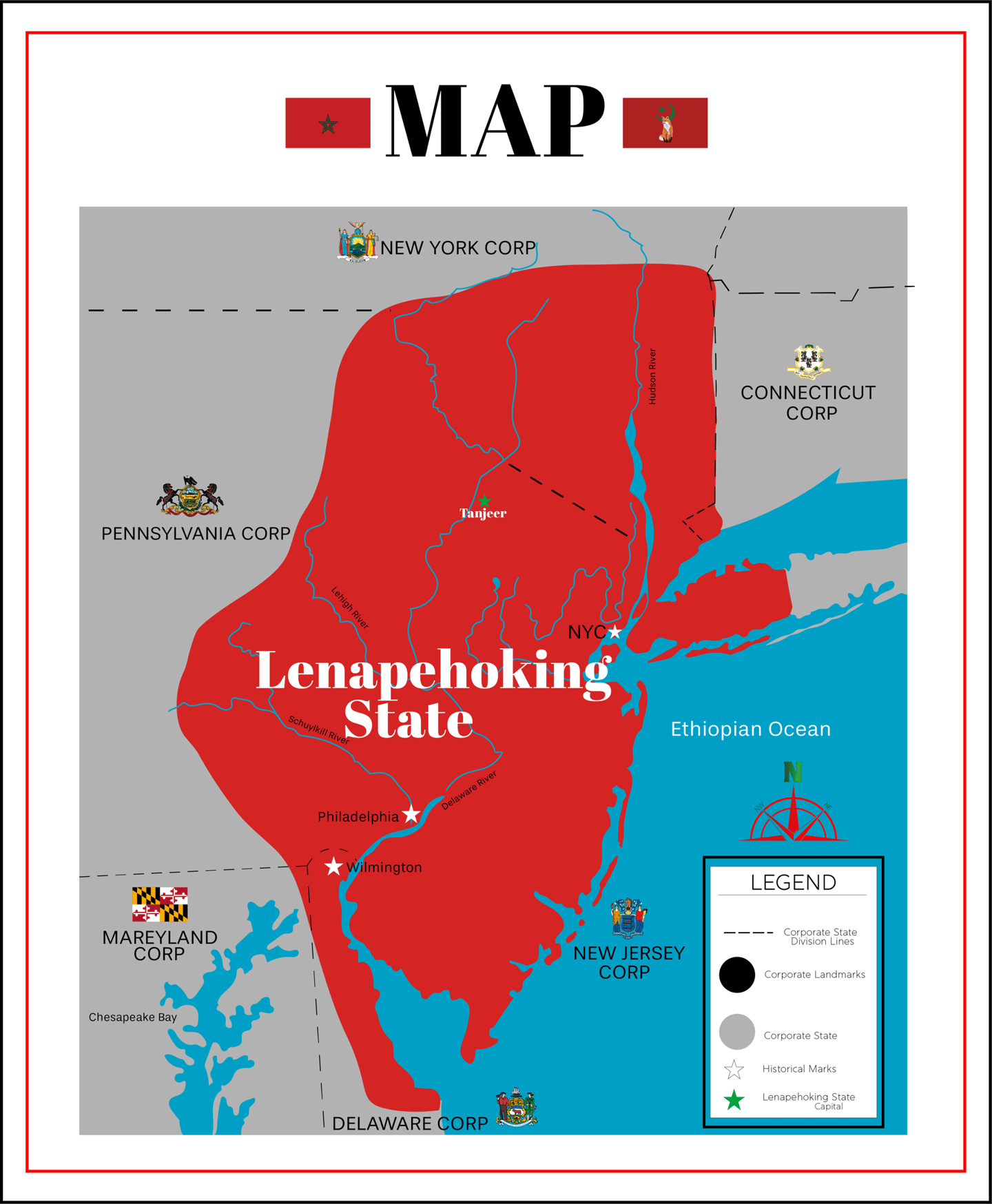
Lenapehoking is a term for the lands historically inhabited by the Al Moroccan people known as the Lenape (renamed the Delaware people by early European settlers) in what is now being referred to as the Mid-Atlantic United States.
Lenapehoking, translating to “in the land of the Lenape.” This term has gained widespread acceptance and is found widely in recent literature on the Lenape.
In the 16th and 17th centuries, the Lenape homeland ranged along the Atlantic’s coast from western Connecticut to Delaware, which generally encompassed the territory adjacent to the Delaware and lower Hudson river valleys, as well the hill-and-ridge dominated territory between them. Relatives of the Algonquian Al Moroccans [Amerindians] whose territories ranged along the entire coast from beyond the Saint Lawrence River in today’s Canada, and the tribes throughout all of New England, down into northern South Carolina, the Delaware Confederation stretched from the southern shores of modern-day Delaware along the Atlantic seaboard into western Long Island and Connecticut, then extended westwards across the Hudson water gap into the eastern Catskills part of the Appalachians range around the headwaters of the Delaware River and along both banks of its basin down to the mouth of the Lehigh.
Inland, the tribe had to deal with the fierce and territorial Susquehannocks; the Delawares’ territory has generally been plotted with boundaries along mountain ridges topped by the drainage divides between the right bank tributaries of the Delaware River on the east—and on the west and south—the left bank tributaries of the Susquehanna and Lehigh Rivers; bounds which included the Catskills, northern parts of eastern Pennsylvania down through the entire Poconos along the left bank Lehigh River. The Schuylkill River and its mouth (future Philadelphia area counties) or right bank Lehigh was contested hunting grounds, generally shared with the Susquehannock and the occasional visit by a related Potomac tribe when there wasn’t active tribal warfare. The greater Philadelphia area was known to host European to Moroccans [referred today as Indians] scontacts from the Dutch traders contacts with the Susquehanna (1600), English traders (1602), and both tribes with New Netherlands traders after 1610
Along the left bank Delaware valley, the territory extended to all of present-day New Jersey, and the southern counties of New York State, including Rockland, Orange, Westchester, and Putnam Counties, Nassau County, and the five boroughs of New York City.
Acknowledgments
With gratitude, NJSACC acknowledges the Lenapehoking (Lenni-Lenape) and the sacrifices of the Lenape people, culture and ancestral homeland in New Jersey, for which we all have been able to thrive. NJ has been the ancestral homeland to the Lenape for over 14,000 years and were forcibly removed and displaced by European colonizers, resulting in a historic diaspora. Some tribal and First nations, officially recognized by the state and federally, maintain communities that still thrive today, located throughout North America, NJ and the greater mid-Atlantic region.
NJSACC | New Jersey's Afterschool & OST Professional Network
University of Delaware
The University of Delaware occupies lands vital to the web of life for Lenape and Nanticoke, who share their ancestry, history, and future in this region. UD has financially benefited from this regional occupation as well as from Indigenous territories that were expropriated through the United States land grant system. European colonizers and later the United States forced Nanticoke and Lenape westward and northward, where they formed nations in present-day Oklahoma, Wisconsin, and Ontario, Canada. Others never leO their homelands or returned from exile when they could. We express our appreciation for ongoing Indigenous stewardship of the ecologies and traditions of this region. While the harms to Indigenous people and their homelands are beyond repair, we commit to building right relationships going forward by collaborating with tribal leadership on actionable institutional steps.
We begin by acknowledging that we are gathered, speaking, and learning on Lenapehoking, the ancestral lands of the Lenape peoples, which settlers call New York City. We do this with humility and gratitude, while recognizing the violence of forced relocation and displacement of the Lenape Peoples with whom this department and university are in an ongoing process of learning. These peoples are known today as the Delaware Nation, in Anadarko Oklahoma; the Delaware Tribe of Indians, in Bartlesville Oklahoma; the Stockbridge-Munsee Community, in Bowler Wisconsin; and the Munsee Delaware Nation, and the Eelūnaapèewii Lahkèewiit, or Delaware Nation at Moraviantown, both in Ontario, Canada.
We acknowledge the need for the recognition of the history of Lenapehoking – a land stolen from, never traded by, the Lenape peoples, who continue to live in New York City and beyond. We acknowledge the systemic and ongoing violence of settler colonialism, and the genocidal violence that resulted in both forced relocation and in physical and psychological trauma perpetrated across generations. We acknowledge in particular that settlers have broken, and continue to break, their treaties with Lenape peoples, beginning with the actions of Henry Hudson and Peter Minuit in first appropriating this land.
We recognize that reparative action requires long-term maintenance and multigenerational efforts to build relationships with the sovereign nations of the Lenape peoples. We commit to upholding an ongoing and living set of commitments with these nations by working directly with Tribal Governments and Authorized Tribal Representatives to ensure our words and actions are in step with our goals.
NYU | STEINHARDT
What is a Land Acknowledgement:
A Land Acknowledgement is a formal statement that recognizes and respects Native peoples as traditional stewards of lands. The statement highlights the enduring relationship between Native peoples and their traditional territories.
Why do we Recognize the Land:
All land in the State of Connecticut was once Native territory, which is why it is our duty to acknowledge that the University of Connecticut a land grant institution, is existing on Native land. It is important to understand the long-standing history that has brought you to reside on the land and to seek to understand your place within that history. Land acknowledgments do not exist in the past tense or historical context: colonialism is a current ongoing process, and we need to build our mindfulness of our present participation. It is also worth noting that acknowledging the land is Indigenous protocol. -http://www.lspirg.org/knowtheland
The Office for Diversity and Inclusion worked with the three co-founders of the Akomawt Educational Initiative to create a land acknowledgment that rightfully recognizes the history of the Native peoples territories. It is important to our office to work with members of the greater Connecticut community to continue our efforts of educating our campus on the value of diversity and inclusion. This initiative continues to fulfill the mission of the Office for Diversity and Inclusion to continue to build a more welcoming and inclusive community.
UCONN | University of Connecticut
Treaty of Fort Pitt
Articles of agreement and confederation, made and, entered; into by, Andrew and Thomas Lewis, Esquires, Commissioners for, and in Behalf of the United States of North-America of the one Part, and Capt. White Eyes, Capt. John Kill Buck, Junior, and Capt. Pipe, Deputies and Chief Men of the Delaware Nation of the other Part.
ARTICLE I.
That all offences or acts of hostilities by one, or either of the contracting parties against the other, be mutually forgiven, and buried in the depth of oblivion, never more to be had in remembrance.
ARTICLE II.
That a perpetual peace and friendship shall from henceforth take place, and subsist between the contracting: parties aforesaid, through all succeeding generations: and if either of the parties are engaged in a just and necessary war with any other nation or nations, that then each shall assist the other in due proportion to their abilities, till their enemies are brought to reasonable terms of accommodation: and that if either of them shall discover any hostile designs forming against the other, they shall give the earliest notice thereof that timeous measures may be taken to prevent their ill effect.
ARTICLE III
And whereas the United States are engaged in a just and necessary war, in defence and support of life, liberty and independence, against the King of England and his adherents, and as said King is yet possessed of several posts and forts on the lakes and other places, the reduction of which is of great importance to the peace and security of the contracting parties, and as the most practicable way for the troops of the United States to some of the posts and forts is by passing through the country of the Delaware nation, the aforesaid deputies, on behalf of themselves and their nation, do hereby stipulate and agree to give a free passage through their country to the troops aforesaid, and the same to conduct by the nearest and best ways to the posts, forts or towns of the enemies of the United States, affording to said troops such supplies of corn, meat, horses, or whatever may be in their power for the accommodation of such troops, on the commanding officer's, &c. paying, or engageing to pay, the full value of whatever they can supply them with. And the said deputies, on the behalf of their nation, engage to join the troops of the United States aforesaid, with such a number of their best and most expert warriors as they can spare, consistent with their own safety, and act in concert with them; and for the better security of the old men, women and children of the aforesaid nation, whilst their warriors are engaged against the common enemy, it is agreed on the part of the United States, that a fort of sufficient strength and capacity be built at the expense of the said States, with such assistance as it may be in the power of the said Delaware Nation to give, in the most convenient place, and advantageous situation, as shall be agreed on by the commanding officer of the troops aforesaid, with the advice and concurrence of the deputies of the aforesaid Delaware Nation, which fort shall be garrisoned by such a number of the troops of the United States, as the commanding officer can spare for the present, and hereafter by such numbers, as the wise men of the United States in council, shall think most conducive to the common good.
ARTICLE IV.
For the better security of the peace and friendship now entered into by the contracting parties, against all infractions of the same by the citizens of either party, to the prejudice of the other, neither party shall proceed to the infliction of punishments on the citizens of the other, otherwise than by securing the offender or offenders by imprisonment, or any other competent means, till a fair and impartial trial can be had by judges or juries of both parties, as near as can be to the laws, customs and usages of the contracting parties and natural justice. The mode of such trials to be hereafter fixed by the wise men of the United States in Congress assembled, with the assistance of such deputies of the Delaware nation, as may be appointed to act in concert with them in adjusting this matter to their mutual liking. And it is further agreed between the parties aforesaid, that neither shall entertain or give countenance to the enemies of the other, or protect in their respective states, criminal fugitives, servants or slaves, but the same to apprehend, and secure and deliver to the State or States, to which such enemies, criminals, servants or slaves respectively belong.
ARTICLE V.
Whereas the confederation entered into by the Delaware nation and the United States, renders the first dependent on the latter for all the articles of clothing, utensils and implements of war, and it is judged not only reasonable, but indispensably necessary, that the aforesaid Nation be supplied with such articles from time to time, as far as the United States may have it in their power, by a well-regulated trade, under the conduct of an intelligent, candid agent, with an adequate salary, one more influenced by the love of his country, and a constant attention to the duties of his department by promoting the common interest, than the sinister purposes of converting and binding all the duties of his office to his private emolument: Convinced of the necessity of such measures, the Commissioners of the United States, at the earnest solicitation of the deputies aforesaid, have engaged in behalf of the United States, that such a trade shall be afforded said nation conducted on such principles of mutual interest as the wisdom of the United States in Congress assembled shall think most conducive to adopt for their mutual convenience.
ARTICLE VI.
Whereas the enemies of the United States have endeavored, by every artifice in their power, to possess the Indians in general with an opinion, that it is the design of the States aforesaid, to extirpate the Indians and take possession of their country to obviate such false suggestion, the United States do engage to guarantee to the aforesaid nation of Delawares, and their heirs, all their territorial rights in the fullest and most ample manner, as it bath been bounded by former treaties, as long as they the said Delaware nation shall abide by, and hold fast the chain of friendship now entered into. And it is further agreed on between the contracting parties should it for the future be found conducive for the mutual interest of both parties to invite any other tribes who have been friends to the interest of the United States, to join the present confederation, and to form a state whereof the Delaware nation shall be the head, and have a representation in Congress: Provided, nothing contained in this article to be considered as conclusive until it nneets with the approbation of Congress. And it is also the intent and meaning of this article, that no protection or countenance shall be afforded to any who are at present our enemies, by which they might escape the punishment they deserve.
In witness whereof, the parties have hereunto interchangeably set their hands and seals, at Fort Pitt, September seventeenth, anno Domini one thousand seven hundred and seventy-eight.
Andrew Lewis, [L. S.]
Thomas Lewis, [L. S.]
White Eyes, his x mark, [L. S.]
The Pipe, his x mark, [L. S.]
John Kill Buck, his x mark, [L. S.]
In presence of-
Lach'n McIntosh, brigadier-general, commander the Western Department.
Daniel Brodhead, colonel Eighth Pennsylvania Regiment,
W. Crawford, collonel,
John Campbell,
John Stephenson,
John Gibson, colonel Thirteenth Virginia Regiment,
A. Graham, brigade major,
Lach. McIntosh, jr., major brigade,
Benjamin Mills,
Joseph L. Finley, captain Eighth Pennsylvania Regiment,
John Finley, captain Eighth Pennsylvania Regiment.
Source:
Indian Affairs : Laws and Treaties
Vol II (Treaties)
Compiled and Edited By Charles J. Kappler LL. M.
Clerk to the Senate Committee on Indian Affairs
Washington, DC : Government Printing Office, 1904